
From Wind-Cutting Noise to Silent Experience — Aerodynamic Design of Hebron’s Low-Noise Fan Blades
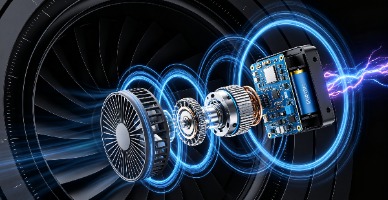
In the portable fan industry, noise control has always been a core pain point affecting user experience. Shenzhen Hebron Technology Co., Ltd., with 20 years of injection molding experience and 15 years of motor fan blade development expertise, has independently developed low-noise fan blades with excellent wind-cutting performance, controlling handheld fan operating noise to below 48 decibels and providing users with a quiet and comfortable experience.
The Physics of Wind-Cutting Noise
Fan noise mainly comes from three sources: motor operating noise, wind-cutting noise, and structural resonance noise. Among these, wind-cutting noise is caused by turbulence and pressure fluctuations when blades cut through the air, making it the primary noise source in portable fans. Traditional fan blades often use simple flat or curved designs, where blade edges generate significant vortices during high-speed rotation, resulting in noticeable “whooshing” sounds.
Airfoil Section Optimization
Hebron Technology’s fan blades adopt an airfoil cross-section design similar to aircraft wings. Through Computational Fluid Dynamics (CFD) simulation analysis, we have conducted multiple rounds of optimization on blade chord length, camber, and thickness distribution, allowing airflow to pass more smoothly over the blade surface and significantly reducing turbulence and vortex generation. With the optimized blades, wind-cutting noise can be reduced by 3-5 decibels at the same air volume.
Coordinated Design of Blade Count and Pitch
The selection of blade count and pitch angle directly affects fan air volume and noise performance. Too many blades increase air resistance, leading to higher motor load and noise; too few blades result in insufficient air volume. Through extensive experimental data accumulation, Hebron Technology has found the optimal balance — using an optimized combination of blade count and pitch in portable fans to ensure sufficient air volume while keeping noise at the lowest level.
BLDC Brushless Motor Silent Tuning
Beyond blade design, the motor itself is also a significant noise source. Hebron Technology uses BLDC (Brushless DC) motors, which, compared to traditional brushed motors, eliminate brush friction noise and operate more smoothly and quietly. Additionally, through precise motor drive algorithm tuning, we further reduce electromagnetic noise and vibration during motor operation.
Soundproof Room Testing and Measured Data
To ensure silent performance, Hebron Technology is equipped with a large soundproof room for fan product noise testing. In the soundproof room, we simulate real usage environments and precisely measure noise levels at different fan speeds. Taking the SD03 handheld fan as an example, noise is controlled below 48 dB at maximum speed, and drops to around 35 dB at low speed, fully meeting the requirements for quiet environments such as offices and libraries.
System-Level Silent Control
The silent experience depends not only on blades and motors but also on the overall structural design. Hebron Technology adopts shock-absorbing pads, optimized air duct structures, and reinforced housing rigidity in product design, eliminating additional noise from structural resonance at the system level to ensure every product leaving the factory meets consistent silent standards.
Future Outlook
As user demands for silent experience continue to rise, Hebron Technology will continue to invest in R&D resources, exploring more advanced noise reduction technologies including intelligent speed adjustment and active noise cancellation algorithms, to bring users an even quieter and more comfortable portable fan experience.